A clicker is not magic, but it is wonderfully clear. Instead of trying to praise a behavior after it has already changed, you mark the exact instant your dog does the thing you want. Then you deliver a reward.
First, charge the clicker
Start with ten to fifteen simple repetitions: click, then give a small treat. Your dog does not need to sit, look at you, or perform. The only job is learning that the click predicts something good. Keep this first session calm and short.
After a few rounds, pause and wait. If your dog looks expectant after the click, the marker is beginning to mean something. That is enough for day one.
Click the behavior, then reward
The click should happen during the behavior, not several seconds later. If you are teaching sit, click when your dog's rear reaches the floor. If you are teaching eye contact, click when the eyes meet yours. The treat can arrive after the click, but the click needs to mark the right moment.
Reward placement matters too. For loose leash work, reward near your leg. For settle practice, reward low and calm. For recall, reward close to your body so coming all the way in becomes valuable.
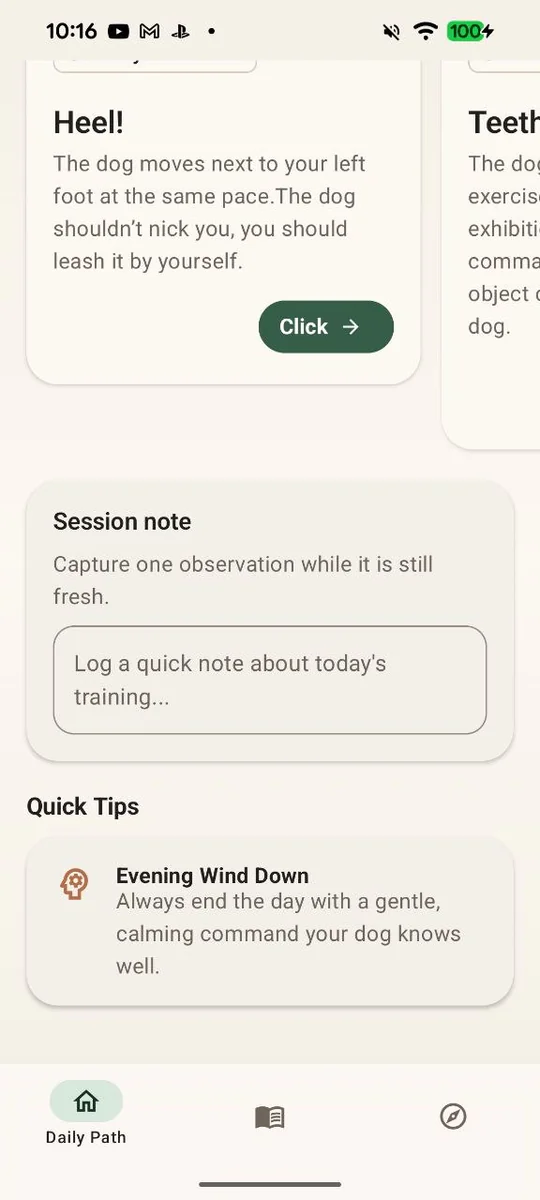
Use the live clicker screen for fast marker practice, then write one sentence in the journal about what timing felt easy or hard.
Best first cues for clicker training
- Name response: click when your dog turns toward you.
- Sit: click as the sit happens, before your dog pops back up.
- Touch: click when the nose touches your hand.
- Leave it: click the moment your dog disengages from the item.
Keep criteria small. If your dog gets stuck, make the next repetition easier. Successful clicker training feels like a game with clear rules, not a test.
Three timing checks for a clear marker
Watch the behavior before you reach for the clicker. The click should land on the choice you want, the reward should follow immediately, and the next repetition should begin only after the dog has finished eating or reset.
If the dog starts watching your hand instead of offering the behavior, hide the treat and lower the difficulty. Practise a few marker-and-reward repetitions without a new cue, then return to the skill with smaller movements and a calmer pace.
Capturing and shaping: two ways to use the clicker
Once the clicker is charged, you can get behaviour in three ways: luring it with food, capturing it when it happens on its own, or shaping it step by step.
- Capturing: wait for your dog to do something you like — lying down on the mat, a play bow, a yawn — then click and treat. It is perfect for natural, relaxed behaviours.
- Shaping: click small steps towards a final behaviour. For "go to your bed": click a look at the bed, then a step towards it, then a paw on it, then all four paws. Each step becomes the new starting point.
A five-minute shaping game
Put a cardboard box on the floor and click any interaction with it: a look, a sniff, a paw, stepping in. Do not point or help. Many dogs become more confident and creative after a few rounds of games like this, and you get very good at timing your click.
Keep clicker sessions short, stop while your dog is still keen, and only click once per behaviour. One click always means one reward.
FAQ
Can I use a marker word instead of a clicker?
Yes. A short word like "yes" can work. A clicker is simply more consistent for many beginners.
What if I click at the wrong time?
Give the reward anyway, then reset. One imperfect click is not a disaster. Your next clean repetition matters more.