Dog training feels easier when progress is visible. Without notes, each session can feel disconnected from the last one. With notes, you can see whether your dog is improving, whether a location is too hard, or whether a reward has lost value.
What to record in a dog training journal
- Cue or skill: what you practiced.
- Location: kitchen, yard, sidewalk, park, or another place.
- Reward: food, toy, praise, sniffing, or access.
- Distraction level: quiet, mild, moderate, or difficult.
- Mood and focus: calm, excited, tired, distracted, or confident.
- Next step: repeat, simplify, increase duration, change location, or add distraction.
Use notes to find patterns
One session does not tell the whole story. A week of notes might show that leash pulling spikes after skipped naps, recall is strong indoors but weak near squirrels, or down-stay works until visitors arrive. These patterns are gold because they show what to train next.
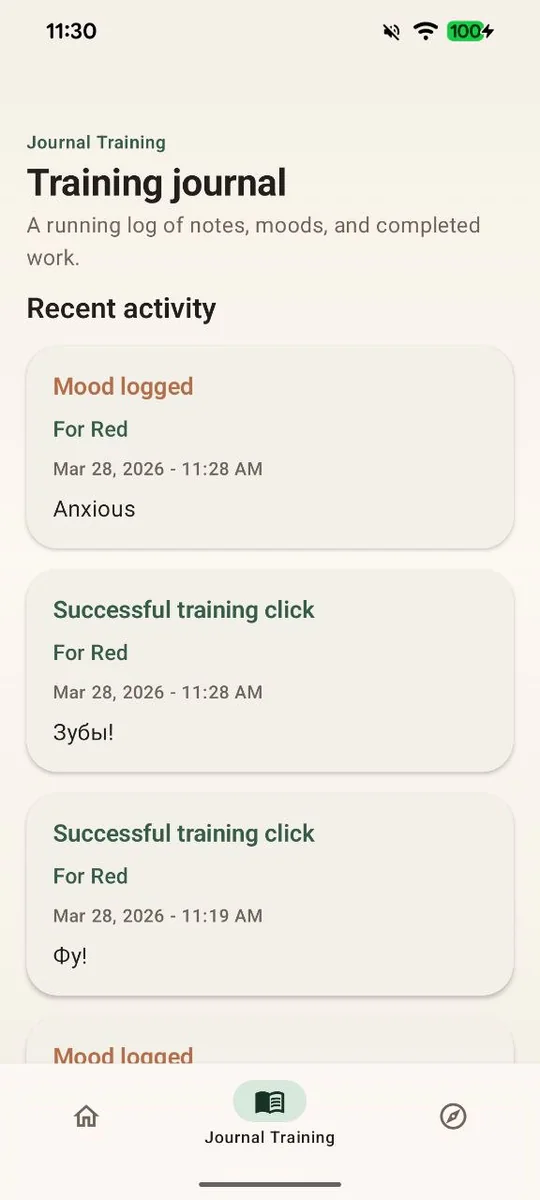
GoodBoy's journal makes this easier by keeping notes close to the training flow instead of scattered across memory, messages, and scraps of paper.
After each session, write one win and one adjustment. That is enough to make tomorrow's training smarter.
Let the journal choose the next step
If your notes show three successful sessions in a row, gently raise the difficulty. If they show confusion, make the next session easier. If they show stress or avoidance, pause the progression and consider whether the setup is too hard.
A journal is not a scoreboard. It is a compass for kinder, clearer training.
A one-minute journal format
Write four short fields after a session: the setting, the behavior you saw, the reward that worked, and the next easier step. Add one body-language observation—loose, worried, over-excited, or tired—so a later entry has context rather than just a success score.
At the end of the week, look for repeated conditions. The pattern may show that the cue is reliable indoors but not near the front door, or that the reward loses value after too many repetitions. That is a training decision you can act on.
Three example entries and what they tell you
A journal becomes useful when entries are short and comparable. Here is what a week of notes on a single skill can look like:
| Day | Entry | What it suggests |
|---|---|---|
| Mon | "Recall, garden, 10 reps, 9 fast. Chicken. Calm." | Ready for a slightly harder setting. |
| Wed | "Recall, park edge, 8 reps, 4 fast. Kibble. Dogs in distance." | Reward too weak for the distraction, or step too big. |
| Fri | "Recall, park edge, 8 reps, 7 fast. Chicken. Same dogs." | Reward value was the missing piece. |
Without the notes, Wednesday would feel like "recall is falling apart". With them, you can see exactly which variable changed and fix it in one session.
Keep the journal honest
Write the entry straight after the session, before you remember it more kindly. Record the failures as plainly as the successes; they are the part that tells you what to change. If several people train the same dog, agree on the same short format so entries are comparable, and glance at the week together on Sunday.
FAQ
Do I need to journal every session?
No, but consistent short notes are more useful than occasional detailed notes. Aim for a quick habit you can maintain.
How detailed should notes be?
One or two sentences can be enough if they capture the skill, location, reward, and next step.