 GoodBoy
Training as a household
Keep Dog Training Consistent Across a Family
Dogs learn from whoever is around, all the time. When one person says "down" for lying down and another says it for getting off the sofa, the dog is not being stubborn — the household is teaching two different things.
Start with a one-page household agreement
Fifteen minutes around the kitchen table saves weeks of confusion. Agree on and write down:
| Topic | Example |
|---|---|
| Cue words | "Sit", "down" (lie down), "off" (paws off furniture/people), "come", "wait", "leave it" |
| Marker | Clicker, or the word "yes" — the same for everyone |
| Release word | "Free" or "okay" ends a sit or wait |
| House rules | Sofa allowed or not? Bedroom? Feeding from the table? |
| Greetings | Attention only with four paws on the floor |
Stick it on the fridge. The most common problem is not different methods — it is different words.
Divide the practice
- Short sessions, several people: three people doing two minutes each is better than one person doing a long session. The dog also learns that cues work with everyone.
- One owner per skill while it is new: one person teaches "down" until it is reliable, then everyone practises it.
- Everyday moments count: sit before the food bowl, wait at the door, four paws for greetings — whoever is there follows the same rule.
Children and training
Children can be excellent trainers with the right tasks and supervision:
- Good jobs: marking and rewarding a sit, tossing a treat for "find it", practising the name game.
- Adults handle leash walking, anything involving guarding food or toys, and new or difficult situations.
- Treats go on an open flat palm or are dropped on the floor, never held in fingers over a puppy's face.
- Teach children to let the dog approach them, and to leave a dog that walks away or is resting in its bed alone.
Keep everyone on the same page
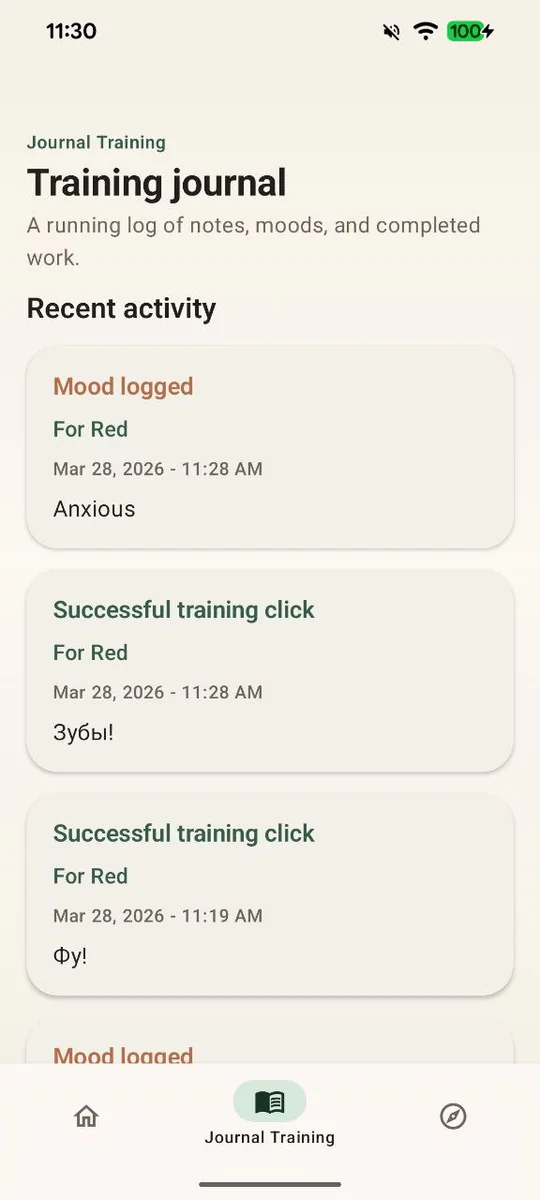
Consistency breaks down when people do not know what others have practised. GoodBoy helps with this even on one shared phone or tablet: each dog has its own profile with completed skills, the Daily Path shows the next session, and the training journal records what was practised and how it went. Reminders prompt the next session, so it does not depend on one person remembering.
Weekly five-minute check-in: what improved, what is still hard, and one thing everyone will do differently. Write it in the journal so it is there next week.
Common household problems
"He only listens to me"
Usually, one person has practised far more. Have the others take over daily cues for a week — with great rewards — and the gap closes.
Someone rewards jumping
Even one person greeting a jumping dog keeps the habit alive. Agree that everyone turns away and greets only when all four paws are on the floor. See how to stop jumping.
Different ideas about correction
Agree on reward-based methods. Leading veterinary behaviour organisations recommend them, and they are the safest choice when children and several adults are involved.
When to get help
If there is growling, guarding, snapping or fear — especially around children — pause training around that trigger and contact your veterinarian or a qualified reward-based behaviour professional.
Frequently asked questions
Should everyone in the family train the dog?
Yes, with the same cue words, marker and rules. Short sessions from several people help the dog learn that cues work with everyone.
Can children help train a dog?
Yes, with simple tasks like rewarding a sit or playing the name game, under adult supervision. Adults should handle leash work and any situation involving guarding or fear.
Can GoodBoy track training for more than one dog?
Yes. Each dog has its own profile with completed skills, and the journal keeps notes from sessions.
Sources and further reading
How this article was created
This article was drafted with the help of artificial intelligence and edited against the app's published feature list. The independent developer is responsible for publication and accepts correction reports. Verify health, safety, legal, financial and official requirements with a primary source or qualified professional.
Questions and corrections: brightwaveapp@gmail.com. Legal and privacy information.